
Naheed Kamal | Tuesday, 11 November 2025 | Print

Shamim Azad, Storyteller
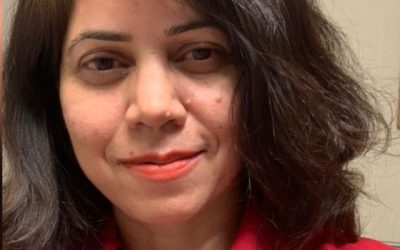
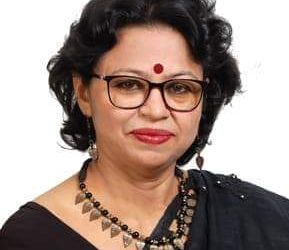
Naheed Kamal
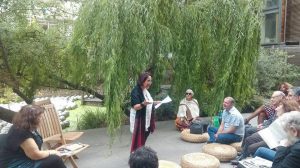
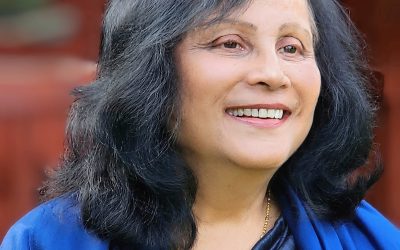
Shamim Azad doesn’t really need any introductions; the prolific author has won countless awards, including the Bichitra Award in 1994, London Arts’ 2000 Year of the Artist Award, Sonjojon – A Rouf Award 2004 and the UK Civic Award in 2004. Fluent in Bangla and English, she has published over a dozen books, novels, short stories, essays, poems and plays, some of which have been included in several anthologies. Sheffield’s Off the Shelf Festival of Writing and Reading described her as “one of Britain’s best-known Bangladeshi writers”. These days Azad lives and works primarily in the UK, where she is a trustee of the One World Action charity, a school governor and Chairperson of the Bishwa Sahitya Kendra (BSK) London.
Her duality amuses her, “When I am in the UK, people are surprised by the Bangladeshi woman who speaks and writes English so well, but when I visit Bangladesh, people say I am so British.” Her experiences give her a nuanced feel for words and languages, which she plays with gleefully, using them for their full effect in everything she does. As a member of the Bangladeshi diaspora in Britain, she works closely with the community in various roles, as teacher and mentor; a new year’s resolution was “to flag up my country (read Bangladesh)” in every possible way, for at least two years, and so we find her compiling and producing anthologies in Bangla and English, developing oral histories and preparing inter-generational projects for publication, conducting workshops and training sessions for teachers, writers and poets, to name just a few of her activities. But in everything she does, she blends education with entertainment.
Incorporating Bangladeshi, European and Asian folklore, poems, stories, oral traditions, chanting, body movement, percussions and music, Azad the performance artist is mesmerizing. Having worked with the composer Richard Blackford, choreographer Rosemary Lee, visual artist Robin Whitemore and many others, its not surprising to such versatility the myriad clips you can easily find online, they all reveal her masterful skills as a storyteller. And the storyteller, as she prefers to call herself, has performed in some of the UK’s most prestigious venues, including the Museum of London, Battersea Arts Centre, the Commonwealth Institute, and the British Library. In Bangladesh, she worked with the British Council and BRAC University; she travels to disparate destinations, such as New York as well as Pakistan, to perform. This year she added one more feather to her cap, participating in one of the world’s biggest cultural events, the Edinburgh Fringe Festival 2011. The Fringe, as it is called, started in 1947 as an alternative to the international festival that’s also held in the historic city; for four weeks every August, performance artists, comedians, musicians, dancers, and everything in between from across the world gather in Edinburgh. Azad the ‘performance poet’ fits in perfectly with the ethos of the Fringe.
We first spoke when Azad rang me in Dhaka, all the way from London, to chat about her ideas for The Fringe. I was referred to her by her daughter Eeshita, whom I’d approached seeking introductions. I would be lying if I said I wasn’t overwhelmed when I learned who was at the other end. To receive a call from Shamim Azad was beyond expectations. I was, as they say in the UK, Gobsmacked! But her story didn’t waste any time on the usual niceties, and we jumped right into a riveting discussion about words, languages, history and the origins, meanings of words, and much more. It was fascinating for me, and also obvious from our conversation that she was excited at the prospect of going to Edinburgh. Following a series of personal mishaps last year, she said, “I was at a loss. It felt like my creativity was all over the place. I was afraid I had lost it. I couldn’t write!” A BRAC University project came along just in time, “It saved me, kept me busy and focused. Creativity survives when you are being creative.” She stated with firm conviction. Many of her ideas for The Fringe were based on breaking the mould of Western-centric sensibilities in the sphere of performance arts, part tongue-in-cheek, she spoke of defying conventions, and breaking the dominance of men at such events; later, I read a series in the Guardian bemoaning how few women made it in the male dominated comedy circuit. The fact that Azad was the first Bangladeshi to take part as a British artist is cause enough for celebrations. She wanted to give audiences a taste of her British-Bangladeshi background, with “a starter, a main course and dessert, like a meal!” she exclaimed. When asked about her inspirations, she said spices. “The stories that linked the East to the West, the journey began in search of spices.” In some ways it was a familiar tale, and it was a story similar to her own journey westward. Sticking to her resolve to promote Bangladesh, a talented Bangladeshi percussionist, Jalal Ahmed, with whom she rehearsed her act on Skype, accompanied her to the Fringe. She called it Tongue Twister Tales, or 3 Ts, it incorporated word play, beatboxing, tabla and music, with which Azad, the storyteller, the performance poet, beguiled the audience.
Azad shared many stories with me, about her various projects, and many of her fascinating ideas, all, which cannot possibly covered in one page. One particular story that struck me as the one that was closest to her heart is the Bijoyphool Project. It started with a stirring piece she wrote for the Dainik Janakantha in 1998, resulting in hordes of letters in response, mostly positive that inspired her to expand on her ideas for a Bangla weekly in London, and eventually included it in her book ‘Bileter Kotha’.
The idea was to find a symbol for what she called “Our Bangladeshi-ness”, what does it mean, she asked in her role as the chair of the BSK London, of those who came to the centre. What do you want to tell your children about who you are, about your culture, heritage, your history, about how Bangladesh came to be an independent nation, what inspired men and women to fight, and about those who fought for freedom and liberty, and what will you share of the victory and the sacrifices? She sought to bridge the gap between generations of Bangladeshis: those who lived through the War of Liberation, those who left home, those born to freedom, and those raised in a foreign land, those who remained, and those who wish to return. Azad clearly has a knack for picking those stories and speaking about issues that are close to people’s heart, she is always acutely in tune with their sentiments.
The Bijoyphool Project is the outcome of her intuitive understanding of what was absent. The project’s success can be measured by considering how easily it has united Bangladeshis living abroad; sadly, we are yet to see it take hold of our imagination in Bangladesh. Since its launch, every year from December 1-16, culminating in Victory Day celebrations, people in the UK and even in Europe can be seen wearing the Bijoyphool on their lapels, the green flower with five petals that are symbolic of the five core principles, with a red centre reminiscent of our national flag, is worn with pride. The perfect symbol of our ‘Bangladeshi-ness’, of a shared history, expatriate Bangladeshis of all generations are drawn to it, especially the young British-Bangladeshis, who are eager for the stories. One aspect of the initiative are events where you can meet freedom fighters or their descendants, who are invited to come and share their stories. They come in droves, they ask questions, they talk, connect and leave better informed, so in a unique way, the Bijoyphool project is indeed helping to bridge the gap.
Azad, the storyteller, knows the power of stories to capture the imagination. Generations talking and listening to each other means better understanding and dialogue at last, and acceptance, there is hope too for closure?). Perhaps a new generation will also be inspired to embark on a journey of their own, leading to self-discovery, back to their roots. In an earlier interview Azad spoke of words and their magical powers, “‘Good storytelling can be powerful, transporting, and magical” But did she sense how these stories would ultimately work such wonders, how did she know it would work at all, to which she already had an answer, “We are all storytellers, whether we realize it or not.”
Shamim Azad’s riveting stories and fascinating work are all worthy of our praise, but ultimately, I believe that what she does with her words and her stories is inspire us to rise above petty patriotism and jingoistic rhetorics, to take pride in who we are and what we can be, as Bangladeshis, at home and abroad.
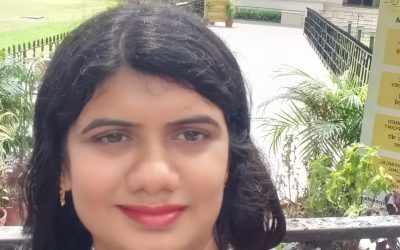
Naheed Kamal
Poet and Author
Writes about the Bilingual Performance Artist,

Posted 2:45 pm | Tuesday, 11 November 2025
globalpoetandpoetry.com | Faruk Ahmed Roni






















































































































































































































































































































































Facebook Comments