
| Saturday, 24 January 2026 | Print
By Nick Brown
Poet and Writer
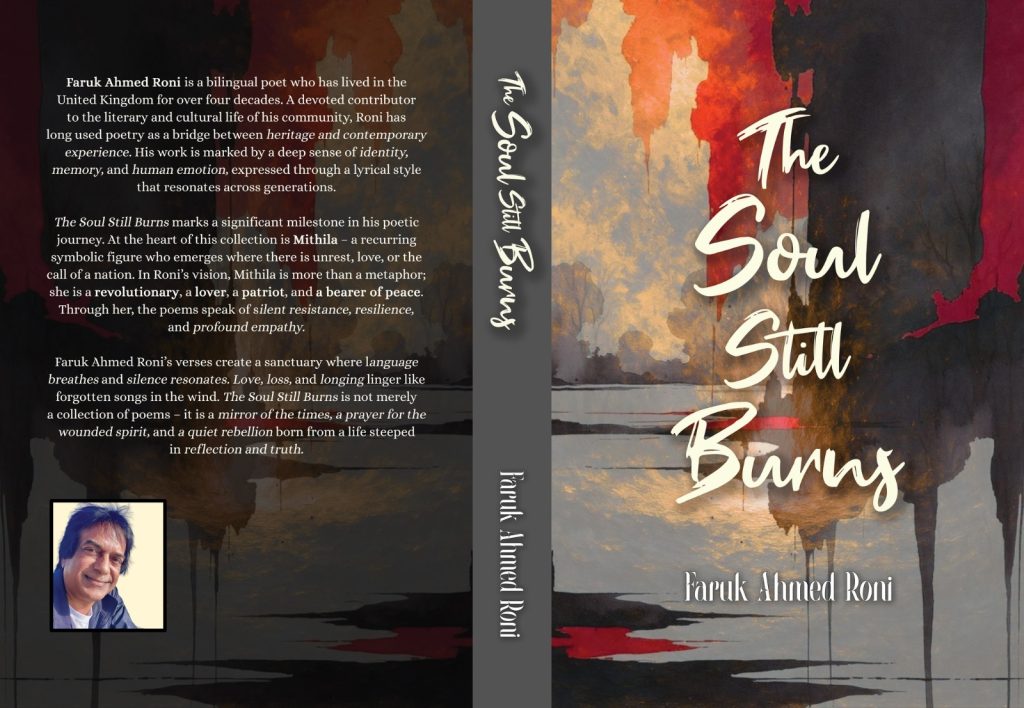
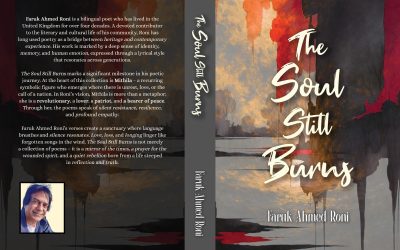
A Collection of Poetry by Faruk Ahmed Roni
Publisher: Staten House, USA
First Published: 2025
Price: £10
Copyright: © Faruk Ahmed Roni 2025
The Soul Still Burns is an expansive, emotionally uncompromising collection of poetry by Faruk Ahmed Roni, published in 2025 by Shikor Global Publishers. It is a work forged from exile, love, political anguish, spiritual inquiry, and unrelenting memory. This is not a book that seeks approval or comfort; it seeks truth. Across more than a hundred poems, Roni constructs a lyrical archive of suffering and survival, personal and collective, while insisting that the human spirit, though scorched, is never extinguished.
From its dedication to “the silent warriors”, those who endure war, oppression, poverty, and dispossession, the book positions itself as both testimony and offering. It is written for women whose “strength speaks through silence,” for children who “dream amid devastation,” and for a future generation symbolised most powerfully by the poet’s daughter, whom he names as his central inspiration. This framing is crucial: The Soul Still Burns is not merely autobiographical poetry; it is ethical poetry, conscious of its duty to remember, to mourn, and to resist forgetting.
Faruk Ahmed Roni writes as a poet shaped by multiple crossings: geographical, emotional, political, and spiritual. Born in Bangladesh and writing from the diasporic experience of Britain, he stands in a long tradition of poets for whom displacement sharpens vision rather than dulls it. His work reflects the ache of leaving rivers, languages, and ancestral soil behind, while also engaging deeply with the alienation of modern metropolitan life.
Roni is a poet of moral consciousness. His voice does not float above history; it walks through it barefoot. War, religious violence, capitalism, migration, loneliness, and the erosion of human values recur throughout the book, not as abstract themes but as lived realities. Yet he is equally a poet of intimacy: love, desire, aging, regret, devotion, and longing are rendered with vulnerability and precision.
Spiritually, Roni occupies a reflective, questioning space. Faith in this book is not triumphalist; it is wounded, searching, deeply human. God appears not as an easy answer but as presence, mercy, memory, and longing. This tension, between belief and doubt, reverence and grief, gives the poems their emotional depth.
The Soul Still Burns is vast in scope. The table of contents alone suggests the book’s ambition: poems of love and loss sit beside political lament, spiritual meditations, urban sketches, elegies for rivers and mothers, and recurring cycles centred on the figure of Mithila.
Rather than a linear narrative, the book functions as a constellation. Certain images, names, and concerns recur- rivers, time, exile, fire, silence, women’s suffering, lost homelands, allowing meaning to accumulate across poems. The repetition is not redundancy; it is insistence. Roni returns again and again to the same wounds because history itself does.
The Veil of Mithila”, Woman as Witness, Memory as Resistance
“The Veil of Mithila” serves as a powerful thematic gateway into the collection. Mithila here is not merely a beloved woman; she is a symbolic figure, part muse, part conscience, part embodiment of oppressed humanity.
The poem dismantles traditional notions of the veil as concealment. Mithila’s veil is “not spun from silk” but “wrapped in the hush of cannon-swept ash.” This immediately relocates the veil from the realm of ornament or modesty to that of history and violence. It becomes a fabric woven from war, poverty, and forgetting.
Crucially, the veil does not blind her. Instead, it sharpens her vision. She sees “the ache in empty hands,” “the quiet division of a shared crust of bread,” and children “whose bellies hold only wind.” Mithila’s gaze is ethical, she looks not at kings or glory but at labourers, mothers, ruins, and hunger.
The poem’s final movement is especially striking. When Mithila lifts the veil, the world does not recoil in fear; it recognises itself. What is revealed is not something foreign or monstrous, but “what we have hidden / beneath the silence / of our own tongues.” Here, Roni implicates the reader. The veil becomes a mirror, forcing confrontation with collective denial.
This poem establishes one of the book’s central ideas: truth is not hidden; it is ignored.
One of the most politically urgent poems in the collection, “The Church, Mosque, and Wall” is a searing indictment of religious violence and moral hypocrisy. Drawing on imagery from Christianity, Islam, and Judaism, the poem collapses theological boundaries to expose shared responsibility. Roni refuses sectarian narratives. Jesus, Abraham, Isaac, Gaza, Jerusalem- all appear within the same moral universe, soaked in blood. The poem’s rhetorical power lies in its refusal to choose sides; instead, it mourns children, innocence, and humanity itself.
The repeated invocation; “O children of Adam”, situates the poem at the level of shared origin. Violence is framed not as political inevitability but as moral failure. The poet’s grief becomes volcanic: seas turn red, bodies dissolve, the self collapses under the weight of inherited hatred.
Importantly, the poem does not end in despair. It ends in a plea- “Let us raise our hands for humanity.” This is not naïve optimism; it is a desperate insistence that civilisation must be reimagined or perish. In a literary landscape often afraid of moral clarity, Roni’s directness is courageous.
This poem stands among the emotional cores of the book. Written as both elegy and prayer, “Mother, A Miraculous Word” elevates motherhood beyond biology into sacred ontology.
The poem fuses Islamic spirituality with universal reverence. The mother is described as the place where the poet “found Allah,” where the universe revealed itself through love. Unlike abstract theology, faith here is learned through care, patience, sacrifice, and moral instruction.
The later stanzas, addressing the mother’s death, are devastating in their restraint. Loss is rendered not through excess but through absence: “I have lost that name today.” The word mother becomes something the poet can no longer speak directly, only remember.
This poem reinforces one of the book’s deepest convictions: love is the most enduring theology.
Across dozens of poems, Mithila reappears in shifting forms: lover, memory, absence, homeland, youth, regret. In poems such as “Waiting for Mithila,” “Mithila, the Melancholy Journey,” and “Mithila, the Unfading Melody,” Roni explores the cruelty of time and the permanence of longing.
These poems resist romantic fantasy. Mithila often does not arrive. When she does, it is too late. Hair has greyed; bodies have aged; life has already passed. Love becomes something remembered rather than lived.
Yet Mithila is not reduced to a symbol of loss alone. She also represents resilience, feminine endurance, and the continuity of desire beyond fulfillment. Through her, Roni interrogates masculinity, vulnerability, and emotional honesty, refusing the trope of the stoic male poet.
This poem is a raw political lament for Bangladesh. Referencing the national anthem and the legacy of liberation, Roni depicts a nation hollowed by corruption, fear, and betrayal.
The imagery is brutal: blood-stained rivers, silenced poets, terrified citizens, vultures circling the map. Even heroes forget. Memory itself becomes endangered.
What makes the poem powerful is its refusal to posture. The poet does not present himself as saviour or revolutionary leader. He admits helplessness: “I can do nothing, nor can anyone.” This honesty prevents the poem from becoming propaganda. Instead, it becomes a cry of conscience.
Roni’s style is marked by:
His diction moves fluidly between the intimate and the cosmic. Rivers, stars, dust, blood, fire, moonlight, these elemental images ground the poems in a mythic register without losing specificity.
There is also a strong oral quality. Many poems feel spoken, prayed, or lamented rather than written. This reinforces the sense that the book is an act of witness rather than performance.
A Necessary Book
The Soul Still Burns is not an easy book, nor does it aspire to be. It is a demanding, courageous, deeply human collection that insists poetry still matters. that it can mourn, accuse, remember, love, and testify.
Faruk Ahmed Roni writes with the awareness that silence is complicity. His poems burn because they refuse to forget: forgotten people, forgotten mothers, forgotten children, forgotten homelands, forgotten values.
This is a book for readers who believe poetry is not merely aesthetic, but ethical, that words can still carry truth through fire.
The soul still burns. And through this book, so does conscience.

Posted 10:04 pm | Saturday, 24 January 2026
globalpoetandpoetry.com | Faruk Ahmed Roni















































































































































































































































































































































































Facebook Comments