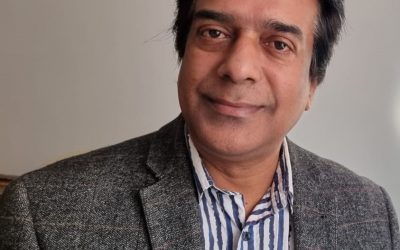
There are occasions in a poetry gathering when a speaker does more than speak about poetry. They make us pause and reconsider why we write, why we create, and what we hope our words might offer another human being.
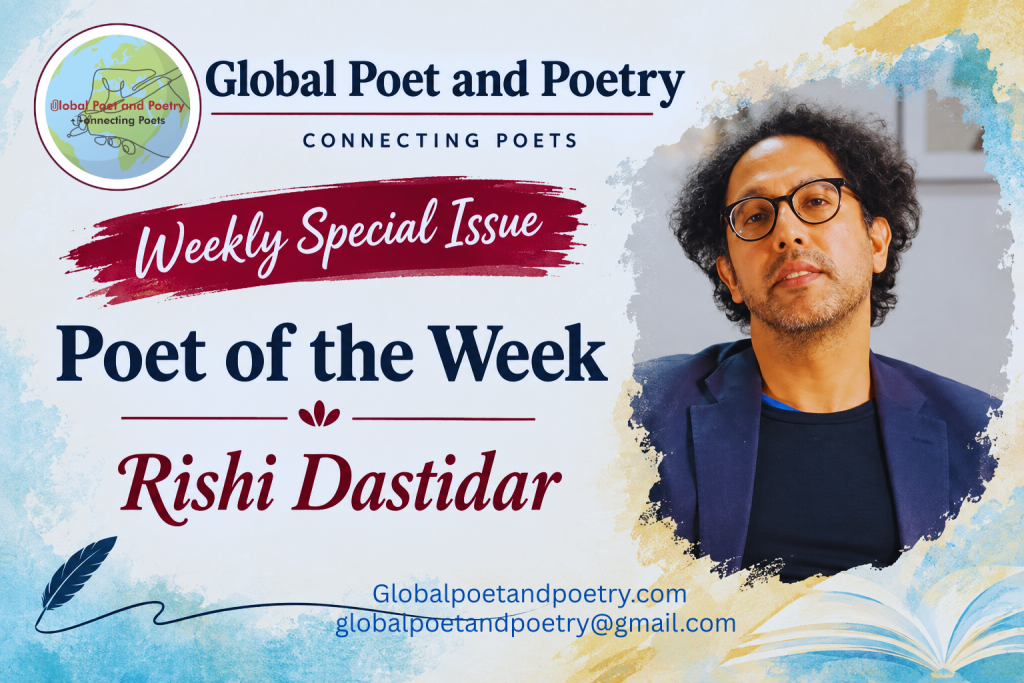
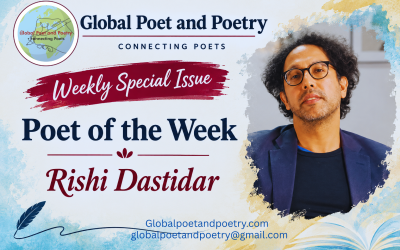
Rishi Dastidar’s contribution to a Global Poet and Poetry online event was one such occasion. His reflections began with something as simple and unexpected as the colour green, but quickly moved into much larger questions: beauty and unease, happiness and creativity, faith and doubt, pain and empathy, stillness and movement. At the heart of his talk was a challenge to one of the ideas often associated with poetry and art: inner peace.
Does poetry give us inner peace? Should it? And perhaps more importantly, should that even be the poet’s purpose?
Rishi approaches these questions with humour, imagination and a willingness to challenge assumptions. He suggests that creation itself may begin with a sense of imbalance, a recognition that something is missing in ourselves or in the world around us. To create is therefore to disturb the existing balance rather than simply accept it.
For Rishi, poetry is kinetic. Writing is kinetic. Living is kinetic. Yet his argument does not end with a rejection of peace. Instead, it arrives somewhere more generous: perhaps the poet’s task is not necessarily to find peace for themselves, but to create a space where someone else may find it, even if only for a moment. One of the most striking images in his talk is that of the cathedral.
Rishi explains that although he is not religious, he finds peace in cathedrals. He then turns that experience into a challenge for poets: build your pain into something that can become peace for others. The poet, in this vision, builds a cathedral out of language, a place a reader can enter when they need to feel understood, less alone, or simply able to breathe for a moment.
We are pleased to publish Rishi’s speech here in the form in which he presented it to the Global Poet and Poetry community. We have preserved his voice, structure, humour and movement of thought, making only very minor grammatical and punctuation corrections where necessary.
At the end of the speech, we are also delighted to publish Rishi’s poem “Melted cockerel”.
There is a natural relationship between the two pieces. His speech considers poetry, faith, belief and the spaces human beings create in their search for meaning. His poem takes us into Notre-Dame, a place of faith, history, ritual, tourism, doubt and contradiction.
Together, they offer readers two different ways of encountering Rishi Dastidar: first through his reflections on what poetry can and cannot do, and then through the concentrated language of the poem itself. We invite our readers to enter both.
Inner Peace Through Poetry?
I am writing this while I should be writing about the colour green in a masterclass I am taking. I suppose that a shade of that colour can soothe. The shade of green in my room is arsenic.
Some greens scare me. A recurring nightmare is that I get trapped by a triffid, a giant walking plant. Plants are aliens after all. Yes, we are all aliens, but still.
I am telling you this because nice things can deliver peace, yes. But also unsettle. Which is the same as poetry.
Which is to say: I have never found inner peace through poetry. I have never found inner peace through art.
Wonder, yes. An expanded view of the world. A sense of possibilities. A richer aesthetic sense. A heart that moves faster, perhaps. But inner peace? No. Can I tease you a little? Why would you want that, inner peace? Sounds nice for kittens, puppies, ducklings. But for poets?
A contention: the happy do not write. Do not create. If you are happy and settled – have inner peace – you do not need to. You, your inner world, the outer world, are in alignment. Harmony. Nothing needs to be corrected, updated, changed. All is in balance. So to create therefore is to upset that balance. Unbalanced does not equal inner peace, to me at least.
Turn it round. We write, we make, we create precisely because we see, feel, know there is a lack in the world. A lack in us. And we hope that what we write, make, create, will fill that gap. And maybe create – restore – that balance. And maybe it does. For a while. But only a while. Because the truth is: inner peace means stillness. And stillness means death. We must move. Creation is kinetic. Writing is kinetic. Living is kinetic.
Now, some of you hearing this will be – rightly – thinking: what a shallow analysis. This man has no sense of philosophical and religious traditions that say, that know that poetry is an expression of the divine, and that revelling in and meditating upon the wisdom that only poets can bring us, share with us, absorbing those into our bodies and minds as fully as we can, then yes we can achieve something that looks and feels like an inner peace.
To which I say: I wish I knew your gods. My god is Pascal. And even then, I do not think I would take the bet. We are humans doing human things. And it is human to want to lessen pain, dodge it. Be calm, be careful, be even. That is not our role. That is not our job, as poets. We arrange words, we do not absolve souls.
We cannot deliver inner peace. At best we can write some words that mean someone reading them goes, someone separate from me in space and time feels this too? I am not alone? That is a noble thing, by the way. To give that to someone. A sense of empathy. A sense that they are understood. And maybe that gives a sense of inner peace to them, for a moment. But do not confuse that with the sense that we as poets must have inner peace. We cannot. We must not. Maybe that is our power. That we give people inner peace at the cost of our own. That is a good trade-off, in my view. Let us keep making it.
A final thought. I am not religious. But I find peace in cathedrals. I love being in them. Spaces designed in some way for peace, I suppose.
Let me challenge you as poets. Do not seek inner peace for yourselves. Build your pain into something that can become peace for others. They do not even need to worship. But know that they can step into that space when they need to.
Write cathedrals for one person. So that readers might find a moment of peace for themselves, within the vaulted arches and beauty and stained glass of your language.
Rishi Dastidar
From reflection to poetry
Having heard Rishi speak about poetry, faith, doubt, pain and the possibility of creating a space of peace for another, we now turn to his poetry itself.
“Melted cockerel” takes us into the charged space of Notre-Dame, where faith, history, ritual, tourism and personal doubt meet. The poem carries many of the tensions present in his speech, but in a more compressed and intimate form.
We leave the introduction here and allow the poem to speak for itself.
Melted cockerel At Notre-Dame
Rishi Dastidar
Selfies under a crown of thorns. An American explains the cockerel to the tour guide; I presume she curses him silently in a third language. A girl in lace, eyes candle-wicked shut, prays to Saint Joan. Her flag is sharp; God, I’d like to believe; how do you do it, turn it on like a tap? Always, they text, with these questions, when you step into this gilded Time Machine. I can read your mind; so I know you said Luther was right. You’d like to lose the fear, disappear? Faith is a texture. Buy the rosary, pretend it’s a bracelet; enjoy the crucifix digging into your veins, gently. Feeling alive isn’t the sin you think it is, but believing it trumps all is.
From Global Poet and Poetry
We are pleased to bring Rishi Dastidar’s reflections and poetry to our readers. His speech asks us to reconsider what we expect from poetry. His poem takes us into a cathedral and into the complicated territory of faith, doubt, history, belief and human experience. Perhaps poetry does not always need to calm us. Perhaps it needs to make us look more closely. To unsettle us. To make us question. To make us recognise something of ourselves in another person’s words. And perhaps, after all that movement and uncertainty, a poem may create a small space where someone else can rest. A cathedral made of words. A cathedral for one person.
Faruk Ahmed Roni Editor Kaberi Mukherjee Assistant Editor Global Poet and Poetry






























































































































































































































































































Facebook Comments